
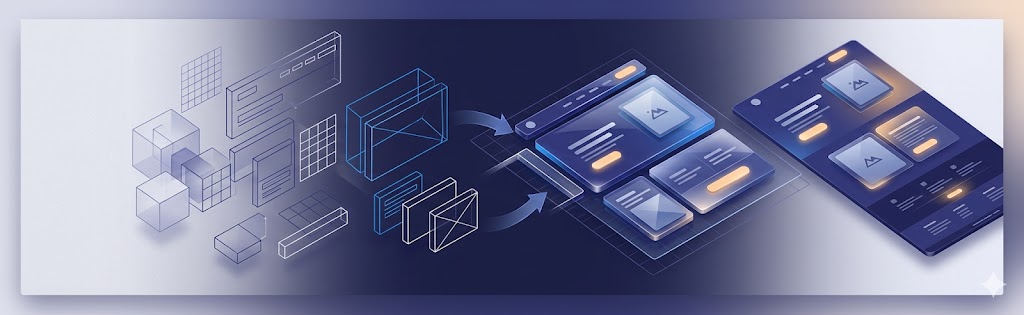
A custom website is the rare purchase where “it looks amazing” can still be a mistake. A gorgeous Figma design means nothing if the finished site ships slow, breaks on a phone, or was built on a page builder you cannot maintain — and that gap between a beautiful design and a well-built site is exactly where most custom projects quietly go wrong. This guide covers both halves: designing something worth building, and making sure it survives the build.
Custom WordPress sites designed from scratch for your brand — agency quality at 40–60% less than US agencies. Built fast, SEO-ready, and 100% owned by you. No themes, no page-builder bloat, no developer lock-in.
Get a Free QuoteCustom WordPress web design means your site is designed from scratch — no pre-built theme constraints. It delivers better performance, stronger brand differentiation, and higher conversion rates than any premium theme.
What Is Custom WordPress Web Design?
Custom WordPress web design is the process of designing and developing a WordPress website from scratch, where every visual element, layout, and user interaction is intentionally created for your specific brand and business goals — rather than adapted from a pre-existing theme. The result is a site that looks and behaves exactly as designed, with no compromise to fit within a theme’s architectural constraints.
This matters because the web is saturated with recognizable theme aesthetics. Visitors can unconsciously detect when a site uses Avada, Astra, or OceanWP just from its layout patterns and spacing rhythms. Custom design signals investment in quality and differentiates your brand from competitors who took the shortcut. In markets where trust and credibility are primary conversion drivers — professional services, healthcare, SaaS, luxury brands — that differentiation has measurable business value.
From a technical standpoint, custom design also means a clean codebase. No unused theme features, no legacy CSS overrides fighting the theme’s defaults, and no performance overhead from features you’ll never use. A well-built custom WordPress theme loads faster, scores higher on Core Web Vitals, and is far easier to maintain than a heavily customized premium theme.
Custom Design vs. Premium Theme: A Detailed Comparison
Initial cost: A premium theme costs $50–$200. Custom design costs $5,000–$50,000+. But the premium theme carries hidden costs: a page builder license ($100–$300/year), a developer to customize it ($50–$150/hour), and ongoing frustration when theme updates break your customizations.
Performance: Page builders like Elementor and WPBakery add 200–500KB of JavaScript and CSS to every page load. Custom-built themes load only what each page actually uses. The performance gap translates directly to Core Web Vitals scores, which affect both user experience and Google rankings.
Uniqueness: Premium themes are purchased by thousands of businesses. There is a non-trivial chance that a competitor in your industry is using the same theme template. Custom design is, by definition, unique to your brand.
Scalability: Custom-built themes are architected around your business model. Adding a new template, a new post type, or a new section takes hours, not days of fighting a theme’s framework. At scale, this compounds into significant efficiency gains.
The Custom WordPress Web Design Process Step by Step
- Discovery & strategy — Understanding your business goals, target audience, competitors, and conversion objectives. This shapes every design decision that follows.
- Information architecture — Sitemap, page hierarchy, and content structure. Determines the navigation and URL structure before a single pixel is designed.
- Wireframing — Low-fidelity layout sketches that establish content hierarchy and page structure without visual design distractions.
- Visual design in Figma — High-fidelity designs for all key templates (home, service pages, blog, contact). Client review and revision cycles happen here, before any code is written.
- WordPress development — Building the approved designs as a custom WordPress theme. Includes custom post types, Gutenberg blocks, and any required plugin integrations.
- Content migration — Moving existing content into the new theme’s structure, formatting it for the new templates.
- QA & testing — Cross-browser, cross-device testing; performance testing; accessibility review; SEO technical audit.
- Launch & handover — DNS cutover, post-launch monitoring, and client training on the WordPress editor.
Key Elements of a High-Converting WordPress Design
High-converting custom WordPress designs share several characteristics that template-based sites struggle to achieve. The above-the-fold section — what visitors see before scrolling — must communicate your value proposition in under 5 seconds. This requires a clear headline, a supporting subheadline, and a single primary call to action, all within a visual hierarchy that guides the eye precisely.
Social proof placement is a conversion lever that custom design optimizes deliberately. Where a theme might offer a “testimonials section” somewhere on the page, a custom design places trust signals — client logos, specific results, testimonials with faces — exactly where skepticism is highest: adjacent to your pricing, next to your primary CTA, and in the header on high-intent landing pages.
How SEO and Web Design Work Together in WordPress
A beautiful website that can’t be found is just an expensive brochure — every site we build ships SEO-ready, baked in from the first line of code, not bolted on afterward.
Custom WordPress design gives you full control over the HTML output, which directly impacts technical SEO. You control heading hierarchy (exactly one H1 per page, logical H2/H3 nesting), image ALT attributes, internal linking patterns, and schema markup. Theme-based sites often generate bloated, semantically incorrect HTML that requires constant workarounds.
Page speed — a confirmed Google ranking factor — is dramatically better on custom-built themes. A custom theme typically achieves Lighthouse performance scores of 90+ compared to 50-70 for heavily customized premium themes. Better scores mean faster-loading pages, lower bounce rates, and higher rankings.
Custom WordPress Web Design Cost and Timeline
A simple 5-8 page brochure site with custom design runs $5,000–$15,000 and takes 4–8 weeks. A mid-size marketing site with a blog, resource library, and a few custom post types runs $15,000–$35,000 and takes 8–14 weeks. A complex site with e-commerce, membership, booking systems, or API integrations starts at $35,000 and can take 16–24 weeks. These ranges reflect US-based agencies; offshore teams cost 40–60% less but require more project management overhead and quality oversight.
Why a Beautiful Custom Design Still Fails
Here is the trap almost no custom-design article mentions: a design is only as good as the code underneath it. A stunning Figma file handed to a developer who drops it into Elementor or Divi comes out as 200–500KB of builder bloat — pixel accuracy slips, the “responsive” version is really just a squished desktop, and the page that looked razor-sharp in the mockup loads slowly and scores in the 50s on Lighthouse. The design was never the problem; the build was.
Protect yourself with three moves. Keep design and development aligned under one team (or teams that actually talk), so the intent survives the handoff. Ask how the design becomes a site — hand-coded from the Figma, or poured into a page builder. And judge the finished build, not the mockup: run the live URL through PageSpeed and open it on a real phone.
Done right, the design and the performance reinforce each other — the hand-coded custom WordPress development builds we ship average 92 on Lighthouse precisely because the code honours the design instead of fighting it. A beautiful site you cannot load fast is not a design win; it is a build you will pay to redo.
How to Choose the Right WordPress Web Design Agency
In our experience building custom WordPress sites, the agencies worth hiring design and build in-house — avoid firms that outsource one or the other. Review their portfolio for sites with original visual identities, not recognizable theme aesthetics. Ask whether they use a page builder (a red flag for custom work) or build custom Gutenberg blocks. Ask how they handle page speed — if they can’t give specific Lighthouse scores for their recent work, that’s a concern.
The best agencies will ask more questions about your business goals and conversion objectives than about your color preferences. Design that isn’t grounded in business strategy is decoration. The right agency treats your website as a growth tool, not a digital brochure.
The argument for premium themes usually sounds reasonable until something goes wrong. A plugin update breaks the CSS overrides. The framework the theme relied on gets deprecated. A security patch conflicts with the shortcodes. Clean code ownership matters less when things go right — and enormously more when they don’t. That’s the practical reason custom builds tend to last longer and cost less to maintain after year two.
Recent Custom WordPress Projects
Real custom builds — what changed, and the measurable results.
- Generic remodeling theme — visually identical to local competitors
- 3.8s mobile load, Google PageSpeed 42
- No local SEO structure, invisible in Google Maps results
- 100% custom UI, brand-exclusive colors, zero template reuse
- Fully optimized, 0.8s load, PageSpeed 94+
- Built-in local SEO, project gallery & online booking form
- Paid generic business theme — frequent plugin conflicts broke the styling on every update
- Laggy form redirects, heavy consultation drop-off
- No structured blog, couldn’t capture long-tail tax SEO traffic
- Hand-written native WP code, modular design — plugin updates never break the layout
- Built-in lightweight lead form & client-confidentiality modal
- Layered blog SEO architecture targeting SMB tax keywords
- Generic e-commerce template, severely homogenized product display
- Sluggish product images, high cart abandonment
- Couldn’t customize brand product modules — limited by the template
- Custom product pages, brand-story page & lightweight cart
- Lazy-load images + static cache, 1.1s product-page load
- Custom product filters & made-to-measure size form for niche apparel
- Old generic industrial template with poor mobile adaptation
- Couldn’t host large equipment galleries or PDF whitepaper downloads
- Bloated pages, very low search-engine indexing efficiency
- Industrial-style custom pages, responsive large-screen equipment gallery
- Built-in whitepaper downloads, dealer quote system & regional distribution pages
- Full technical SEO, lifting industrial keyword rankings
Why Work With Us
What you actually get when you choose a custom build with our team.
From Figma to a hand-coded custom theme — one team, no outsourcing handoffs, no quality gap between design and development.
The same custom, conversion-focused quality a US agency charges $15k–$50k for — without the US agency overhead. Transparent, fixed quotes.
Standard WordPress, clean documented code, no proprietary page builder. Any developer can maintain it — you are never locked in to us.
Semantic markup, optimized Core Web Vitals, PageSpeed 90+ on every build. SEO structure baked in, not bolted on afterward.
Frequently Asked Questions
A theme is a pre-built design you customize within its predefined limits. Custom design starts from original Figma files and is built as a unique theme with no pre-existing constraints. Every layout, interaction, and visual element is intentionally created for your brand. There are no unused features, no theme-inherited styles to override, and no aesthetic compromises imposed by someone else’s design decisions.
It can be, mainly through performance and clean markup. A custom build loads only what’s needed, hits better Core Web Vitals, and outputs semantic HTML — all of which help rankings. A well-optimized theme can also rank fine; the SEO risk with themes is bloat from page builders and unused features. Custom design gives you tighter control, but content and links still do most of the SEO work.
Custom WordPress web design costs $5,000–$15,000 for simple brochure sites, $15,000–$35,000 for mid-size marketing sites, and $35,000–$80,000+ for complex sites with e-commerce, membership, or custom application functionality. Offshore agencies cost 40–60% less. The investment pays back through better conversion rates, lower long-term maintenance costs, and superior page speed compared to theme-based alternatives.
A theme is the pragmatic choice when budget and timeline are tight and your needs are standard. Go custom when the site is central to your business, brand differentiation matters, you need specific functionality, or you keep hitting a theme’s limits. A practical path: start on a solid theme, move to custom once the business case is proven.
A truly custom WordPress site starts with original design files, is built as a bespoke theme (not a child theme of a commercial theme), uses custom Gutenberg blocks rather than a page builder, and contains only the features your business actually needs. No template aesthetics, no page builder overhead, no plugin bloat. The design reflects your brand identity rather than any theme framework’s aesthetic defaults.
Yes, if it’s built that way. A good custom build exposes editable content through the block editor and theme settings, with reusable patterns and clearly structured templates, so you can update text, images, and sections without a developer. Ask up front for an editable, block-based build and a short handover doc — that’s what keeps you independent after launch.
Timeline ranges from 4–6 weeks for a simple site to 16–24 weeks for complex builds. The largest variable is client feedback speed — design revision cycles can add 2–4 weeks if approvals are slow. Content readiness is the other major factor; sites where content is provided in final form before development begins consistently launch 30% faster than those that finalize content during the build.
Typically: discovery and requirements, wireframes, visual design (often in Figma), then development of a custom theme, content population, QA across devices, and launch. Each stage has a review point. The biggest time savers are finalized content and designs up front and clear decisions on which sections need to be merchant-editable.
Yes. Every custom WordPress site we design is fully responsive, built mobile-first so it looks and works correctly on phones, tablets, and desktops. With most traffic now on mobile, responsive design is a baseline requirement, not an add-on, and it also supports your SEO and conversions.
Yes. We build clean, semantic markup, optimize images and assets for Core Web Vitals, and set up an SEO-ready structure (titles, meta, schema, sitemaps). Custom design avoids the plugin and code bloat of generic themes, which is one reason custom builds usually load faster and rank better.
No. You own the site, the code, and the content, and it runs on standard WordPress, so any competent developer can maintain it. We document the build and structure it cleanly so you are never dependent on a single person to make changes.
Page builders like Elementor let you assemble pages visually from prebuilt elements – fast and editable, but often heavier and constrained by the builder. Custom design is coded to your exact spec for maximum performance, flexibility, and clean output. We can also build custom, then hand you a block or builder setup for easy editing – getting both.
Because a design is only as good as the code built under it. A beautiful Figma file dropped into a page builder like Elementor or Divi comes out heavy (200-500KB of extra code), loses pixel accuracy, is often just a squished desktop layout on mobile, and loads slowly – scoring in the 50s on Lighthouse where a hand-coded build scores in the 90s. To avoid it, keep design and development aligned, ask whether the design will be hand-coded from Figma or poured into a builder, and judge the live site with PageSpeed and a real phone, not the mockup.
Tell us about your project — pages, features, and timeline — and we’ll send a fixed-scope quote within 24 hours. No obligation, and you own 100% of the code we deliver.
Related Resources
Related WordPress design and development services to take your project further.
Custom WordPress Development
Hand-coded WordPress builds — engineered for speed, SEO, and growth.
View serviceCustom Theme Development
Purpose-built WordPress themes with zero page builder overhead.
View serviceGet a Free Quote
Tell us about your project and receive a detailed estimate within 24 hours.
Get a Free Quote